Merchandising, at its core, is about selling clothing, accessories, and other products that feature designs people want to wear or display. But what separates merchandising from simply buying a plain t-shirt at Zara? The answer lies in the design itself: specifically, in how that design makes someone feel seen, validated, or part of something larger than themselves. This is where internet culture becomes a goldmine for print-on-demand sellers.
Today’s generations are deeply embedded in online communities. They spend hours scrolling through TikTok, sharing memes, and participating in viral trends. Being “chronically online” has become its own cultural identity, a phrase that’s both self-deprecating and a badge of honor. When someone asks their coworker, “Did you see that TikTok?” and gets an enthusiastic yes, they’ve just confirmed membership in an invisible club. This shared knowledge creates connection, makes people feel witty and in-the-know, and most importantly for merchandisers, creates demand for products that signal this membership to others. Keep reading and learn how to design merch inspired by internet culture without being cringe.

Why Internet Culture Works for Print-on-Demand
The relationship between internet culture and print-on-demand is almost symbiotic. Internet trends move fast. Something can explode on Monday and feel ancient by the following weekend. Traditional manufacturing models can’t keep up with this pace. You’d need to predict trends weeks in advance, produce inventory, store it, and hope you timed it right. By the time your products arrive, the trend might already be dead.
Print-on-demand solves this problem entirely. You can spot a trend emerging, create a design, and have it available for sale within hours. There’s no inventory risk, no warehouse full of outdated references, no financial commitment beyond the time spent creating the design. You upload the file, and the product only gets made when someone orders it. This speed-to-market advantage is precisely what makes POD the perfect vehicle for capitalizing on internet culture, especially when you’re using a tool like the Merch Designer to create or adapt designs as quickly as trends appear.

The appeal goes beyond logistics, though. Wearing a shirt with an internet culture reference is fundamentally different from explaining the joke to someone. It’s a passive form of communication that says, “I’m part of this community, and if you recognize this, you are too.” It’s the difference between asking if someone saw a meme and wearing that meme. Both create connection, but one does it silently, creating moments of recognition between strangers who share the same digital spaces.
The Critical Importance of Timing
Understanding the Lifecycle of a Trend
Here’s where most sellers fail: they misunderstand the lifecycle of a trend. And there’s actual theory behind this.
The diffusion of innovations curve, also called the technology adoption lifecycle. While it was originally developed for technology adoption, it applies perfectly to internet trends. The curve shows five stages: innovators, early adopters, early majority, late majority, and laggards.
For merchandising purposes, you need to catch trends during the early adopter phase, the moment when something has enough momentum to be recognizable but hasn’t yet saturated the mainstream. This is an incredibly narrow window, sometimes lasting only days.

Let me give you a concrete example: the “very demure, very mindful” video. This phrase exploded across TikTok, became the framework for thousands of videos, and felt genuinely funny and fresh for roughly two to three weeks. During that peak period, everyone was in on the joke. It felt clever to reference it. Then, seemingly overnight, it became cringe. The phrase went from being the height of internet humor to something you couldn’t say aloud without people rolling their eyes.
This wasn’t random. It follows a predictable pattern. A trend is only interesting when you’re an early participant. Once your parents, your boss, and major brands start using it, the trend has reached the late majority phase, and by then, it’s no longer cool. The very thing that made it appealing (being part of an in-group) disappears when everyone is in the group.
This creates a harsh reality for merchandisers: if you’re just hearing about a trend, you need to act immediately. You cannot wait even one more day. Your window might be as short as 72 hours. You might see a spike in sales for a few days or weeks, then nothing. But that spike can be significant enough to make the effort worthwhile, if you’re fast enough.
How Cultural Meaning Shifts (and Why It Matters)
The “girl dinner” and “girl math” trends illustrate another dimension of this timing issue. These phrases started as genuinely funny observations about certain behaviors. “Girl dinner” originally referred to the relatable experience of eating a random assortment of snacks and leftovers when cooking a proper meal feels like too much effort: crackers, cheese, maybe some pickles, whatever’s in the fridge. It was self-aware humor about low-effort meals that many people, regardless of gender, could relate to. The joke was in the honesty of it, the recognition that sometimes we just don’t have it together enough to make real food.
“Girl math” followed a similar pattern, starting as tongue-in-cheek justifications for purchases: “If I return something, that’s free money, so buying something with that returned money means it’s free”. The humor came from acknowledging the mental gymnastics people do to justify spending, presented with deliberate absurdity. Everyone recognized the flawed logic, that was the entire point. It was playful self-deprecation.

Early adopters made content that felt fresh and relatable. Merchandisers who jumped on these trends early likely did well. But as these phrases became ubiquitous, their meaning shifted. They became associated with a particular type of person who uses cutesy language to avoid accountability, someone who doesn’t take financial responsibility seriously and hides behind the “I’m just a girl” defense. What started as lighthearted humor became cringe, and eventually, became associated with behaviors that many people actively dislike.
This raises an important strategic question: are you a seller that capitalizes on trends while they’re genuinely cool, or are you a store that sells to people who are always late to the party? Both can be profitable, but they represent fundamentally different brand identities. One is associated with being in-the-know, the other with being behind the curve. You need to decide which market you’re serving.
The Art of Adaptation: Why Being Literal Fails
Once you’ve identified a trend worth pursuing, your next challenge is how to translate it into a design. This is where most sellers make critical mistakes. The instinct is to be as literal as possible. To directly quote the viral phrase, recreate the exact image, or copy the format exactly as it appeared online. This approach fails for multiple reasons.

First, being completely literal means you’re competing with everyone else who noticed the trend, even the creator. You’re not differentiating yourself in any way. Your design is just one of hundreds that look essentially the same, and unless you have some other competitive advantage (better products, lower prices, massive advertising budget), there’s no reason for someone to buy from you specifically.
Second, literal reproduction doesn’t read as cool, it reads as trying too hard. There’s a subtle but important distinction between genuinely participating in internet culture and awkwardly attempting to capitalize on it. When you copy something exactly, it feels corporate and calculated, even if you’re a small independent seller. It breaks the illusion that this merchandise represents authentic participation in the culture.
Third, and most seriously, literal copying exposes you to legal risk. If you directly quote a content creator’s specific joke, catchphrase, or format, you’re potentially infringing on their intellectual property. While some references are so widely used that they might fly under the radar, you’re still at risk if the original creator decides to protect their work. Many viral creators are increasingly savvy about monetizing their content, and they don’t appreciate others profiting from their intellectual property without permission.
How to Adapt Trends Strategically
The solution is strategic adaptation. You need to walk a careful line: your design must be obviously referencing the trend (otherwise people won’t recognize it and won’t buy it), but it must be different enough to avoid being a mindless copy.
Take the “very demure, very mindful” example we already used, and imagine we’re in August of 2024. No one owns the word “demure.” You could’ve created a design that uses just “very demure” without the full phrase. Or you could’ve played with the format: “very [something else], very [something else]” that maintains the cadence and structure but uses completely different words that are funny in their own right. The key is that people who know the trend will immediately recognize what you’re referencing, but you’re not just slapping the exact quote on a shirt.
This approach works for aesthetic trends too. Take Charli XCX’s “Brat Summer” as a perfect example, the entire trend was built around a specific visual identity: that distinctive lime green color, lowercase typography, and a particular party-girl-who’s-a-mess-but-owns-it energy. You didn’t need to reproduce Charli’s album cover exactly (and legally, you couldn’t). Instead, you could capture the essence: use that electric green in your own design, adopt the chaotic-yet-confident aesthetic, reference the lifestyle and attitude without copying specific imagery. Someone seeing your design would immediately recognize the Brat connection, but you’ve made it your own. This works for any visual trend, whether it’s a color palette, illustration style, or design format. The goal is to capture what makes the trend appealing and recognizable without directly reproducing the original.
Finding Trends Before They’re Mainstream
If you’re not naturally “chronically online,” finding these trends before they hit the mainstream requires intentional effort. You can’t passively wait for trends to come to you. By the time something reaches you organically, it’s likely already too late.
TikTok is the undisputed king of trend discovery. It was the first social media platform to perfect the algorithm-driven feed. Before TikTok, social media operated on a following model: you saw posts from people you followed, in chronological or algorithmically ranked order, but still fundamentally limited to your network. TikTok changed everything by creating a “For You” page that shows content based on your interests, watch time, and engagement patterns, regardless of whether you follow the creator.
This algorithmic approach means TikTok is where trends are born. By the time a trend migrates to Instagram, it’s usually already transitioning into mainstream consciousness. TikTok is where you can still find trends young enough to capitalize on.

However, TikTok’s algorithm won’t automatically show you trends, you have to train it. This is a painstaking but necessary process. You need to consistently interact with trending content. When you spot something that might be emerging as a trend, engage with it: like it, comment, watch it multiple times, look at related videos. The algorithm learns what you’re interested in and shows you more of it. You cannot simply search for trends; you need to be in the flow of the platform, consuming content regularly, so trends appear in your feed naturally while they’re still fresh.
Another option is to subscribe to trend-tracking newsletters or services. Vexels, for example, includes trend research in their Merch Digest reports, identifying emerging trends while they’re still early. These services employ trend researchers whose job is to stay on top of everything happening across platforms. They typically focus on broader trends rather than specific viral moments, but they can give you a baseline understanding of what’s gaining momentum.
Twitter (now X) is another platform where trends often originate, particularly for text-based memes and conversational trends. The platform’s structure encourages rapid-fire commentary and quote-tweeting, which can make phrases or jokes spread quickly. Like TikTok, X uses an algorithmic feed that can surface trending content beyond your immediate network. The platform functions as a real-time conversation engine where jokes, phrases, and formats can go viral within hours.
The key across all platforms is consistency. You can’t check TikTok once a week and expect to catch trends at the right moment. This needs to be part of your regular routine: ideally daily, even if just for 15-20 minutes. You’re essentially doing market research, and like any research, it requires sustained attention.
Executing Fast: From Trend to Product
Once you’ve identified a trend and figured out how to adapt it, speed becomes everything. Your workflow needs to prioritize getting the design created and listed as quickly as possible.
If you’re a designer yourself, this means dropping whatever else you’re working on. That other design project can wait. A trend won’t. You need to immediately sketch out your concept, figure out how you’re adapting the reference to avoid copyright issues, and execute the design. Remember: you potentially have a 48-72 hour window before the opportunity stops being profitable.
If you’re not a designer, you need a system that lets you create trend-ready designs just as fast. With Vexels, you can move at the pace trends demand: mix and modify stock graphics, adjust templates, generate merch-ready artwork with AI, and build complete designs directly in the Merch Designer without waiting on anyone else. Whatever your setup, it needs to be immediate, because in POD, “I’ll get to it next week” usually means the trend is already gone.

Before you start the design process, though, you must have already figured out your adaptation strategy. Don’t start creating until you know exactly how you’re going to make this reference work without copying someone’s intellectual property. This planning should happen immediately after you identify the trend, not during the design process. Time spent revising a design because you realized mid-way through that it’s too literal is time you don’t have.
Matching Design and Product to Audience
Every trend has a specific audience, even if it seems like “everyone” is participating. Part of your job is identifying who that audience actually is and tailoring both your design aesthetic and product selection accordingly.
The “man in finance” trend, for instance, had a clear primary audience: women, particularly those in the dating scene. The viral sound (“I’m looking for a man in finance / trust fund / 6’5″ / blue eyes”) resonated with a specific demographic through its satirical take on dating standards and materialism. Understanding this means you can make smarter decisions about design style (perhaps something playful with typography, leaning into either the satirical humor or the aspirational aesthetic, incorporating colors and fonts that resonate with that audience) and product selection (products that this demographic actually buys and wears: tote bags, phone cases, crop tops, sweatshirts, maybe even wine glasses or water bottles).
Your product choices should reflect what’s actually trendy within the context of the reference. T-shirts are always a safe baseline, they’re the bread and butter of print-on-demand and work for almost any design. But consider cuts and styles that are currently fashionable. An oversized t-shirt or a baby tee might resonate more with a younger, trend-focused audience than a standard unisex tee.

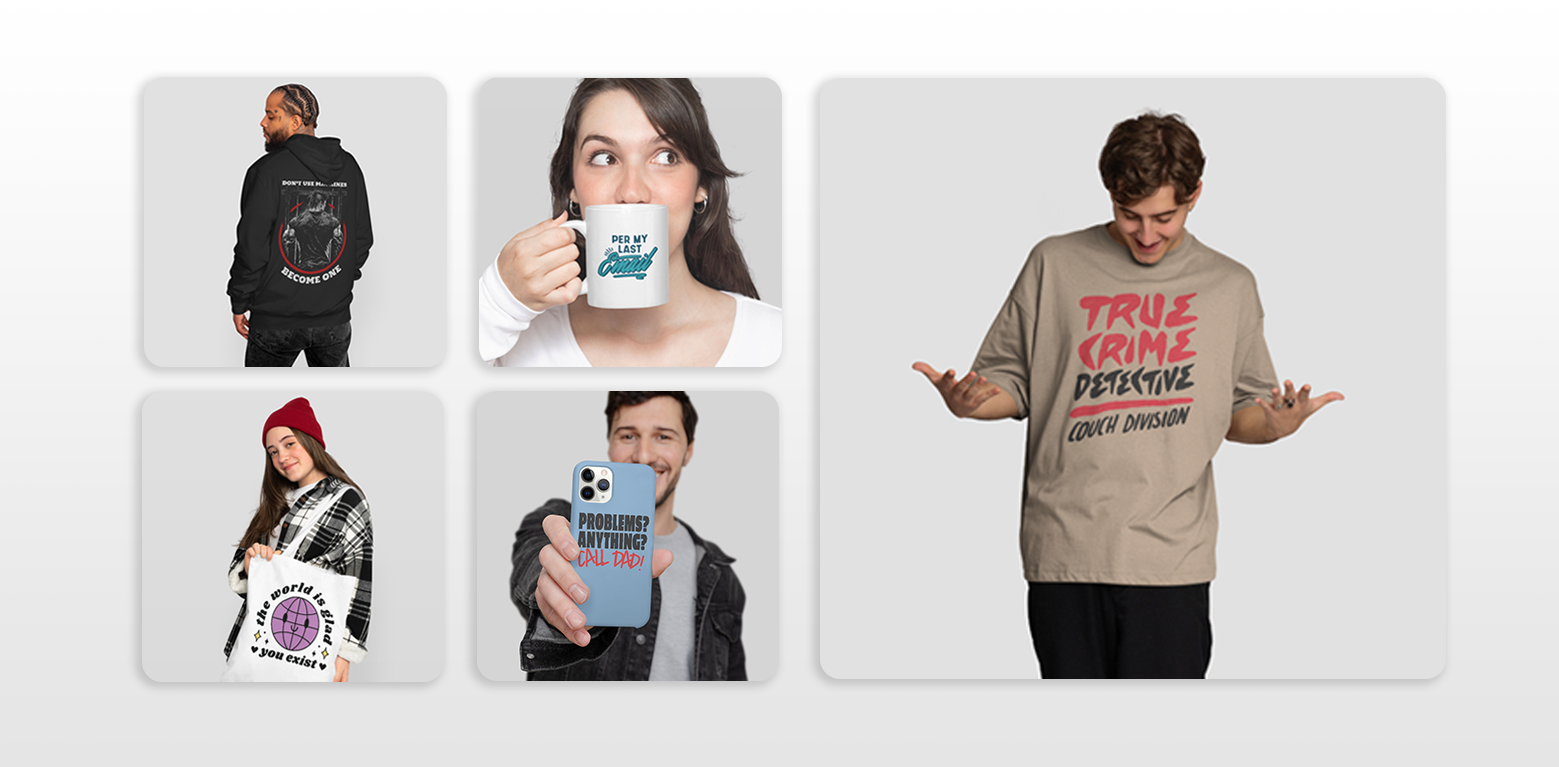
Beyond t-shirts, think about products that align with being trendy: phone cases (everyone has one, they’re visible, they’re replaced frequently), tote bags (practical, visible, popular with younger demographics), hoodies, stickers, mugs. Products that people use in public or semi-public settings work best because they allow the wearer to signal their cultural participation to others.
Conversely, avoid products that don’t align with the trend-conscious mindset. You can generally sense which products feel current and which feel dated. If something seems like what your parents’ generation would buy, it’s probably not the right choice for internet culture merchandising.
The Bottom Line
Capitalizing on internet culture through print-on-demand merchandising is absolutely viable, but it requires a specific mindset and approach. You need to be genuinely embedded in online spaces, or willing to put in the work to become so. You need to act with extreme speed when you spot an opportunity. You need to be creative enough to adapt references without directly copying them. And you need to understand that most of these designs will have a short shelf life, they’re not evergreen products that sell steadily for years.
The sellers who succeed in this space are those who accept these constraints and build their business model around them. They’re not looking for stable, predictable income from a catalog of timeless designs. They’re looking for those quick spikes: the rush of sales when you’ve caught a trend at exactly the right moment and created something that resonates with people who are deep in that same cultural moment.
The difference between success and cringe comes down to genuine cultural fluency, strategic adaptation, and ruthless speed. If you can master those three elements, internet culture merchandising can be one of the most exciting and profitable niches in print-on-demand.